
FREE SHIPPING ON ORDERS OF $150 CAD+
FREE DELIVERY
ORDERS OF $150 CAD+

We get questions about this everyday and realize how honing rods are probably one of the most misunderstood tools in the kitchen. Most people assume they “sharpen” knives… but nope — that’s not what they’re meant to do.
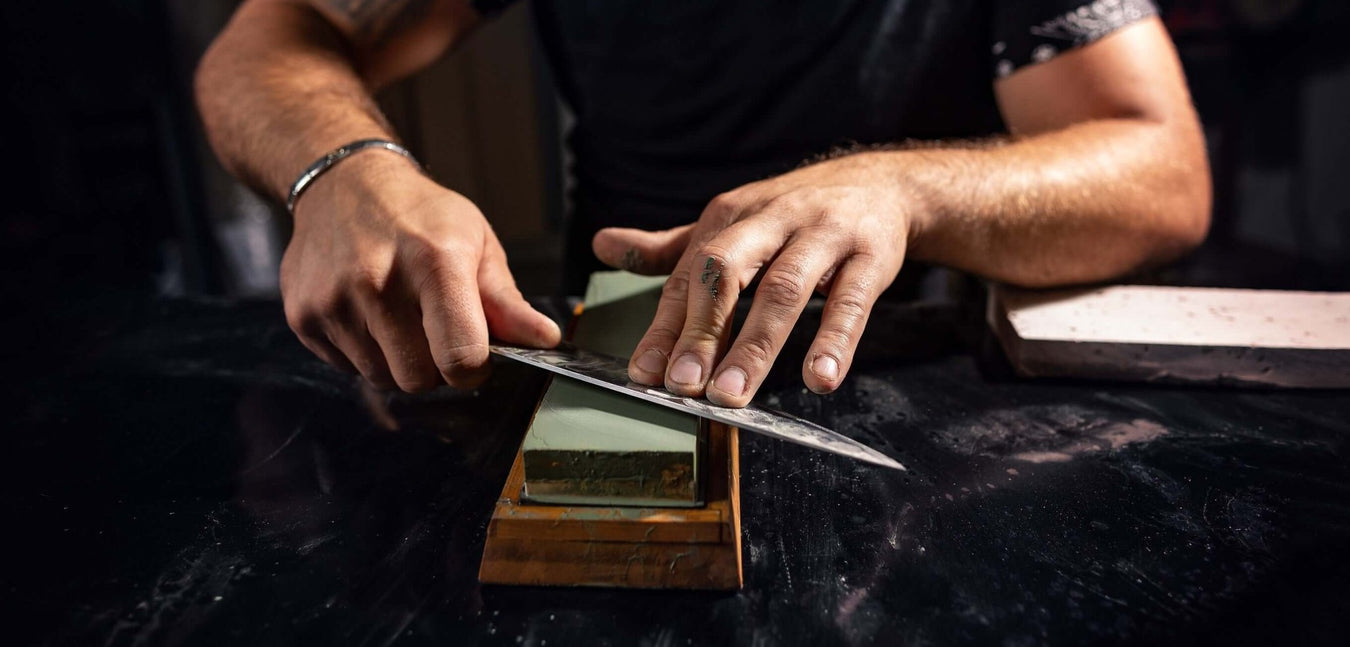
A honing rod doesn’t actually sharpen in the classic sense. It doesn’t grind metal away like a sharpening stone. What it really does is realign the edge that bends slightly during normal use. Think of it like straightening your knife’s spine and giving it a light polish so it feels sharp again.
Now, some folks like to argue that a rod does remove metal because it leaves streaks on the surface. And yes — technically, it can remove a tiny, tiny amount of material so let's not debate useless points, your right if it makes you happy. But the true purpose of a honing rod isn’t to shave metal off like a sharpening stone. The abrasive effect is so minimal that we almost treat it as “removes nothing.” The streaks are mostly residue from realignment and microscopic polishing, not actual sharpening.
Here’s the simple breakdown:
❌ Sharpening = Removing metal on a stone to create a new edge.
✅ Honing = Putting your existing edge back where it belongs.
Both are required to keep your knives in a good condition. Now let's jump into the key differences of 2 rod styles you will see on the market:
Metal rods are the traditional option — the ones everyone has seen in cheap knife sets, commercial kitchens, or butcher shops. They’re basically everywhere. But just because they’re common doesn’t mean they’re ideal, especially for today’s harder steels.
Most metal honing rods were designed back when kitchen knives were much softer. On modern blades sitting around 59 HRC and up, a metal rod is often too soft to do anything meaningful… and in some cases, it can even roll or damage the edge instead of realigning it.
They still work fine for softer Western knives, restaurant workhorses, or the typical grocery-store knife set — which is why you see them so often. But for Japanese knives, high-carbon steels, or anything with a harder heat treatment, ceramic rods are simply better suited.
❌ Too soft for knives 59+ HRC
❌ Can actually bend your edge the wrong way
❌ Works poorly with Japanese or high-carbon blades
✅ Decent for softer European knives (54–57 HRC)
Diamond rods are a whole different beast. They’re extremely abrasive — honestly closer to a micro-sharpening tool than a true honing rod. That’s why you see them more often in butcher shops or heavy commercial kitchens than in places that use high-quality blades.
Because of that diamond coating, every stroke removes metal — not gently, but aggressively. And that’s where the trouble starts. With just a few quick or careless passes, you’re no longer maintaining the edge… you’re reshaping the blade without realizing it.
Instead of keeping the edge straight, a diamond rod can easily create an uneven, misaligned apex, slowly throwing off the geometry of your knife over time.
❌ Remove too much metal for daily use
❌ Can scratch or tear softer cladding layers
❌ Too aggressive for most Japanese knives
❌ Shorten blade life when used frequently
✅ Useful for very specific heavy-duty maintenance (rare for kitchen knives)
Ceramic rods are the sweet spot — easily the best choice for most modern kitchen knives. They’re hard enough to handle today’s higher-HRC steels, but gentle enough not to tear into the edge like a diamond rod or bounce off it like a soft metal rod.
Instead of grinding metal away, a ceramic rod focuses on realigning and lightly polishing the edge. That’s why it keeps your knife feeling sharp longer without changing the blade’s geometry.
Smooth, controlled, effective — exactly what you want for maintaining a good knife. For daily or weekly upkeep, ceramic is simply in a different league.
✅ Hard enough for steels 58–65 HRC
✅ Gentle and smooth — won’t damage the edge
✅ Polishes while realigning
✅ Perfect for Japanese, carbon steel, and premium stainless
❌ Not meant to “sharpen,” only maintain — but that’s exactly its purpose
Using a honing rod regularly keeps your knife feeling sharp and performing properly between sharpening sessions.
✅ Realigns the edge
✅ Adds a light polishing effect
✅ Extends time between sharpenings
❌ Does NOT fix chips
❌ Does NOT fix a dull knife
❌ Does NOT replace sharpening stones
If you want your knives to stay sharper longer with less sharpening — 100% yes. A few gentle passes before cooking or every few meals is enough to keep your edge tight and consistent. No pressure, no force, no samurai cosplay needed.
How to use it:

Metal is too soft for most quality knives. Diamond is too harsh for everyday use. Ceramic hits the perfect balance of hard, gentle, and consistent — which is exactly why it’s the only honing rod we sell. If you want to maintain your knives properly (espacially any higher-end blade), a ceramic rod is hands-down the safest and most effective choice.
Comments
Leave a comment